
Leadership comes in many styles. Not everyone is going to be receptive to one style. If one style of leadership is working in a company that doesn’t mean it will be a success in a different company. In Figure1, we can see some of the
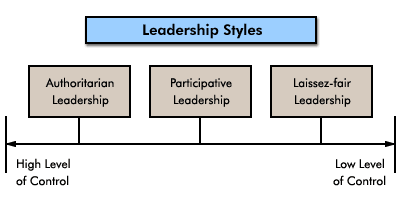
Figure 1; Source: http://www.jsw.org.au
According to (9 Common Leadership Styles: Which Type of Leader Are You? – TEC 2019). The most famous Leadership Styles are
- Transformational Leadership
- Transactional Leadership
- Servant Leadership
- Autocratic Leadership
- Laissez-faire Leadership
- Democratic Leadership
- Bureaucratic Leadership
- Charismatic Leadership
- Situational Leadership
The present world has made leadership harder and harder. Competition levels have increased, and a lot of pressure has been exerted by several bodies. The modern world demands a leader that can adverse in these conditions. The 20th century leadership theories are not suitable for knowledge-based economies. Others have criticized how theories of leadership are mostly male theories based on Western practices of working.
Females are more likely than males to indicate that they use an interactive style of management called transformational leadership. This leadership style was found to be correlated with several management skills associated with success. (Burke and Collins 2001)
The focus on more recent theories necessarily means to neglect classical leadership approaches, such as the trait approach, the behaviour or style approach, and the situational leadership approach. These theories are criticized for their determined and narrow perspective, which fails to cover leadership reality. Classical approaches assume that there is a unidirectional personal influence of the leader on the followers (Winkler 2013). On the other hand, contemporary leadership addresses the issues of gender, empowerment, team leadership, and shaping the moral dimension of leadership. Females hindered leadership positions in the traditional styles of leadership and the transition is not yet complete.
CHALLENGES
The following are the challenges faces by a leader
• Developing Managerial Effectiveness—The challenge of developing the relevant skills—such as time management, prioritization, strategic thinking, decision-making, and getting up to speed with the job—to be more effective at work.
• Inspiring Others—The challenge of inspiring or motivating others to ensure they are satisfied with their jobs; how to motivate a workforce to work smarter.
• Developing Employees—The challenge of developing others, including topics around mentoring and coaching.
• Leading a Team—The challenge of team-building, team development, and team management; how to instil pride in a team or support the team, how to lead a big team, and what to do when taking over a new team.
• Guiding Change—The challenge of managing, mobilizing, understanding, and leading change. How to mitigate change consequences, overcome resistance to change, and deal with employees’ reaction to change.
• Managing Internal Stakeholders and Politics—The challenge of managing relationships, politics, and image. Gaining managerial support and managing up; getting buy-in from other departments, groups, or individuals.
RECOMMENDATIONS
- Customize the Leadership
- More Strategic Approach
- Give preference to Customers
FUTURE DEVELOPMENT
Leadership is one of the skills I am lacking. Identifying your weakness is an important part of development. Acknowledging the problem and tacking it head on is the way to go ahead. Since I am from my leadership style is eastern influenced.The main challenge for a company who decide to expand globally is to be able to manage cultural differences. From earlier research, a foreign company in China must deal with the lack of a Western leader that understands Chinese culture and a small Chinese employee able to work well in Western multinational corporations (Wang 2011).
A study shows that project managers that they can adapt their leadership behaviours in order to enhance subordinates’ organizational commitment, improve work performance, and consequently increase a positive working atmosphere (Limsila and Ogunlana 2008). As I evolve as a Leader and a human I will try to adapt my strategies and take into account that there is no one size-fits-all approach to leadership
Reference
9 Common Leadership Styles: Which Type Of Leader Are You? – TEC (2019) available from <https://tec.com.au/resource/9-common-leadership-styles-which-type-of-leader-are-you/> [13 April 2019]
Winkler, I. (2013) Contemporary Leadership Theories Enhancing the Understanding of the Complexity, Subjectivity and Dynamic of Leadership. Heidelberg, Neckar: Physica-Verlag
Wang, B. (2011) Cultural understanding is essential for effective leadership in China [online] available from <https://www.hrmagazine.co.uk/article-details/cultural-understanding-is-essential-for-effective-leadership-in-china > [17 March 2019]
Burke, S. and Collins, K. (2001) “Gender Differences In Leadership Styles And Management Skills”. Women In Management Review 16 (5), 244-257
Limsila, K. and Ogunlana, S. (2008) “Performance And Leadership Outcome Correlates Of Leadership Styles And Subordinate Commitment”. Engineering, Construction And Architectural Management 15 (2), 164-184
 Shebin's Leading In a Changing World Blog
Excellent Blog. I had a question while reading the Challenges a leader face. How do you inspire people?
LikeLiked by 1 person
Hi Shijil, Thank you for the feedback. Hope you enjoyed the blog.
Inspiring people is a tough job. You have to know the person, be charismatic and must have a lot of confidence. A leader must inspire other people. If the leader appears timid or unprepared, the team will pick up on that mentality and begin to show unsatisfactory performance as they feel unease with the leader.
LikeLike
What do you think is much better, a practical approach of a leadership or a theoretical approach of a leader?
LikeLiked by 1 person
Hi sharm123,
Thanks for going through the blog. I really appreciate it.
According to me, Leadership is more of a practical approach. Yes, Theoretical knowledge is required to tackle complicated obstacles, but the leader should be action-oriented.
I hope this answers your question
LikeLiked by 1 person
What is the impact for UK after Brexit?
LikeLiked by 1 person
BREXIT has been a massive challenge for the United Kingdom. There is nothing like this that happened in history. The impact on the UK will be massive. The currency is expected to go down. The housing prices are going to go down. There will be a dip in the economy of the UK and the companies involved with the UK will suffer some complications.
Thanks for the question and hope you enjoyed the blog
LikeLike
Nice blog with a very interesting video..
LikeLiked by 1 person
Thank you.Hope you found it informative as well..
LikeLike
Good job Shebin, What kind of Leadership are you most likely to follow?
LikeLiked by 1 person
HI Sandra, That’s an interesting question. Actually, In my other blog, I went into detail about this. I am more of a Situational Leader and I found out that I am most receptive to the style of situational leadership as well.
Thanks for taking the time out to read my blog and commenting on it.
LikeLike